 Bookmark this on Delicious
 Recommend at StumbleUpon
There are two aspects of wind that people commonly measure: Speed and direction.
"Measuring" either can be done at a very simple level... or you can get sophisticated. Just the sort of challenge I find fun!
I have separate pages about the sensors for wind speed and wind direction. Mostly they talk about commercially available units, and there's also some information on making your own.
By all means, have fun, make your own sensors.
But in the long run, for reliable, hassle-free measurements of the wind (and other weather phenomena) you will probably want to turn to commercially available devices.
The devices will, quite literally, be "out in all winds and weathers", and they will probably be up on a roof, pole, or tower... making servicing them annoying. I'm the first to "have a go"/ "try to make something work". But weather sensors need to be robust.
Even if you "give in", and buy a professionally made device, remember that an extra twenty minutes mounting it well, and doing a good job on the outdoor cables may give you an extra six months before you have to go back and do it again.
Moving on...
Some weather sensors come with integrated packages for interpreting the output of the sensors. These pages do not cover such packages, although when the sensors are available separatelyI, perhaps as replacement parts, they are covered.
Some sensors are part of a "range", i.e. the same manufacturer offers both a speed and a direction sensor. I will try to cross reference such devices.
A design matter... whether you are making your own, or buying something: For both speed and direction sensing, and other phenomenon, many sensors are built around a magnet on a moving part interacting with one or more reed switches (or Hall effect magnetism detectors) on a non-moving part of the device.
These are wonderfully simple, reliable components, very weather resistant, and A Good Way To Go, in general.
Software...
What do you mean by windspeed? Direction? Are you speaking of the maximum gust for the day? The hour? Do you mean the most frequent speed or direction in the past ten minutes?
If you are buying (or using freeware) other people's solutions, then the following make for criteria while choosing. But for extra fun, write your own software! Some things to consider while planning...
How should windspeed or direction be displayed? Speed is pretty easy... Direction- less so.
Even in displaying speed, the obvious answer may not be the easiest to program. One alternative is to plot a simple count/time graph showing how many times the sensor head has gone around. Besides being much easier to program, it has real advantages, once you learn to read it, which isn't too hard... just unfamiliar, at first. Master it, and calculus makes more sense than it did before!
Displaying historical wind direction is an even more delightful challenge, especially if you want your display to show the difference between a day with a nice steady wind, and one when the wind changes it's direction capriciously. Some would say that your wind "direction" graph should show that there was "no" direction when there was very little wind.
Two systems seem, to me, to be good. Both are based on circular "graph paper", and both are dynamic. By this I mean they are not like, say, a thermograph plot, with time the x axis, temperature the y axis. Both of the wind direction systems I like present changing "pictures", like the picture on a radar screen is dynamic. For a history of the day's wind, you'd need to take snapshots of the display from time to time. In both cases, they give a good idea of what is happening now, and what has happened recently.
The first draws lines from the center of the circle outward. If the wind has been towards the north most of the time, there will be a long, or fat, or brightly colored line from the center of the circle towards it's top, the traditional direction for "north" on the printed page. This basic idea can have many variations, depending on what you want to show.
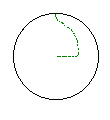
The second scheme requires you to declare the wind to be from just one direction at any given moment. The direction it is from now gives rise to a dot on the edge of the circle. Again, if the wind is from the north, the dot is at the "top". The direction the wind was from five minutes ago gives rise to a dot one millimeter in from the edge of the circle. The direction the wind was from ten minutes ago gives rise to a dot two millimeters in from the edge of the circle... and so on. If you did a time-lapse movie of the graph, you would see the line being "sucked" into oblivion at the center of the circle. I don't fancy programming this display, but it would certainly give plenty of information. The dots could be drawn in different colors to indicate the windspeed. If the sampling period was short, you would be able to distinguish days of steady wind and swinging wind. The following shows a time when the wind is blowing towards the north. On the oldest part of the graph (at the center), we see that the wind was blowing to the east. We can see that the change happened quite smoothly and rapidly.
Forgive me for this reminder?... At the top of this page, I "advertised" separate pages for you about wind speed sensors and wind direction sensors.
Be sure to check other pages of this site for things which might have appeared on this page, but were either mis-sited or had a more general relevance. For instance, look at what I said on the page about counters. The page about opto-couplers may also be useful. An optocoupler would let you use a more robust voltage in the long wire to the sensor, and then shift the signal down to something more microprocessor-friendly nearer (in centimeters) to the electronics watching the sensor.
Apologies... this paragraph should not be necessary, but I have some old links that will point here. If you were looking for the information on the Argent Data Systems wind sensors, that information is now on a page of it's own. If you are feeling very kind, please send me the URL of the page which sent you here? Sorry!
 Page tested for compliance with INDUSTRY (not MS-only) standards, using the free, publicly accessible validator at validator.w3.org